

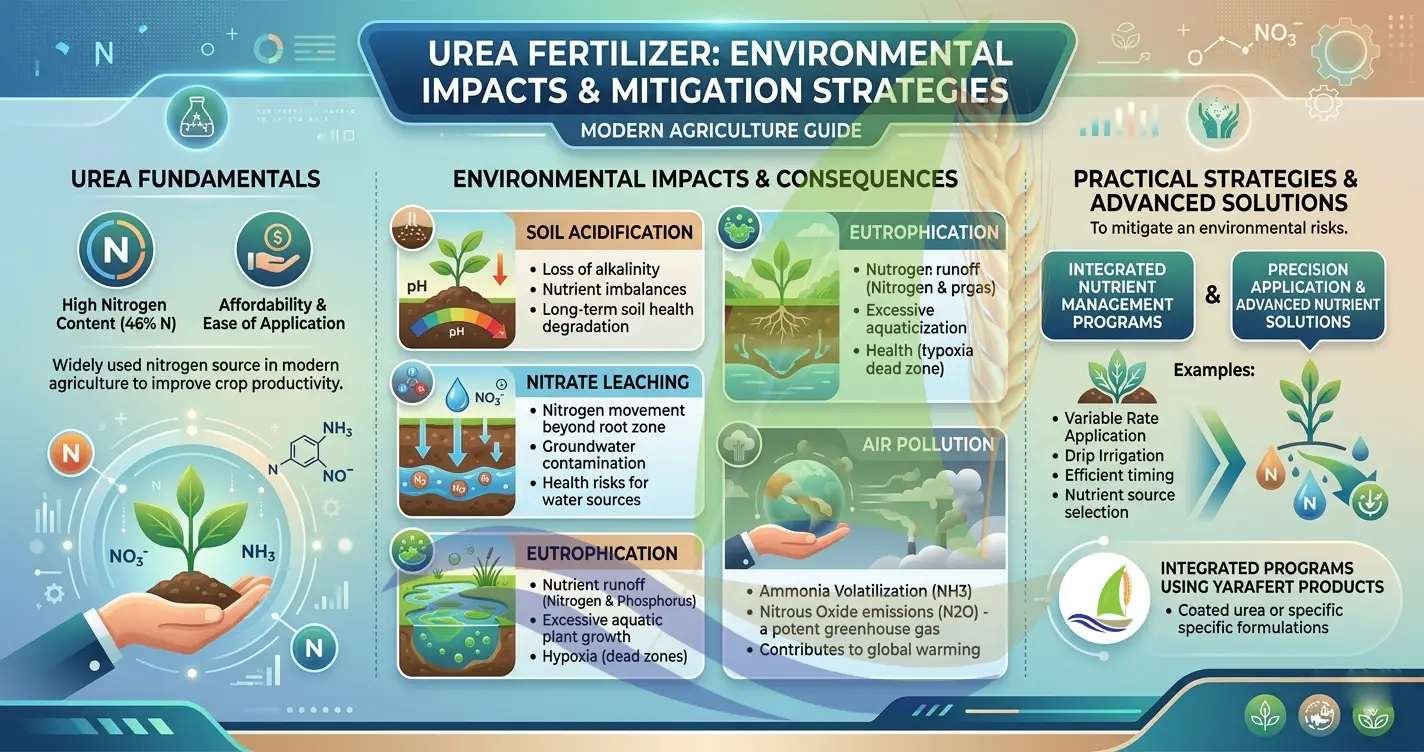
Urea fertilizer remains one of the most widely used nitrogen sources in modern agriculture due to its high nitrogen content (46% N), affordability, and ease of application. However, while urea fertilizer significantly improves crop productivity, its environmental consequences require careful management and scientific understanding.
This comprehensive guide reviews the environmental effects of urea fertilizer, including soil acidification, nitrate leaching, eutrophication, and air pollution, while highlighting practical strategies and advanced nutrient solutions—such as integrated programs using Yarafert products—to mitigate environmental risks.
Urea Fertilizer and Soil Acidification
Soil acidification is one of the most important long-term environmental effects associated with repeated urea fertilizer use. When urea fertilizer is applied to soil, it undergoes hydrolysis followed by nitrification, which releases hydrogen ions (H?) and gradually lowers soil pH.
Chemical Reactions Involved
The acidifying effect of urea fertilizer can be summarized in the following simplified reactions:
| Stage | Reaction | Result |
|---|---|---|
| Hydrolysis | CO(NH?)? + H?O ? 2NH? + CO? | Ammonia formation |
| Nitrification | NH?? ? NO?? + 2H? | Acid generation |
| Overall Effect | Increased H? concentration | Soil pH decline |
Lower soil pH can lead to several agronomic problems, including:
- Reduced nutrient availability, especially phosphorus
- Increased aluminum (Al³?) toxicity
- Decline in beneficial microbial activity
- Decreased crop productivity over time
To counter these effects, balanced fertilization strategies are essential. For example, integrating micronutrient-rich solutions such as SULFOMIX—containing Iron (6%), Zinc (3%), Magnesium (3%), Manganese (2%), Copper (2%), Boron (3%), Sulfur (11%), and Molybdenum (0.2%)—can support soil fertility and nutrient balance when urea fertilizer is used intensively.
Similarly, the inclusion of organic-enhancing products like Biofast, enriched with humic and fulvic acids (24% each), helps buffer soil acidity while improving nutrient uptake efficiency.
Nitrate Leaching from Urea Fertilizer
Another major environmental concern associated with urea fertilizer is nitrate leaching. After nitrification, nitrogen from urea fertilizer converts into nitrate (NO??), which is highly soluble and easily transported through soil profiles into groundwater.
Factors Influencing Nitrate Leaching
Several environmental and agronomic factors determine the extent of nitrate loss:
- Soil texture (sandy soils have higher leaching potential)
- Rainfall or irrigation intensity
- Timing of urea fertilizer application
- Crop nitrogen uptake efficiency
- Root zone depth
To better understand nitrate movement, the following simplified transport mechanism applies:
| Step | Process |
|---|---|
| 1 | Urea hydrolysis into ammonium |
| 2 | Nitrification into nitrate |
| 3 | Water infiltration carries nitrate downward |
| 4 | Nitrate reaches groundwater |
Excess nitrate contamination in groundwater poses risks such as:
- Drinking water pollution
- Health concerns like methemoglobinemia
- Reduced nitrogen use efficiency
- Economic losses for farmers
To reduce nitrate losses from urea fertilizer, combining nitrogen sources with potassium and sulfur nutrition improves plant uptake efficiency. Liquid formulations such as Ugarit K-T-S 25 (36% K?O and 25% SO?) enhance nutrient utilization, supporting stronger root development and reducing nitrogen escape into deeper soil layers.
Urea Fertilizer’s Role in Eutrophication
Eutrophication occurs when excessive nutrients—particularly nitrogen and phosphorus—enter water bodies, stimulating excessive algae growth. Improper management of urea fertilizer is a significant contributor to this environmental phenomenon.
How Eutrophication Develops
Understanding eutrophication requires recognizing its sequential stages:
- Excess urea fertilizer is applied to agricultural fields
- Rainfall carries nitrate into nearby rivers or lakes
- Nutrient-rich waters stimulate algal blooms
- Oxygen levels decline due to decomposition
- Aquatic organisms experience stress or death
The process can be represented conceptually as:
Nutrient Input ? Algal Bloom ? Oxygen Depletion ? Aquatic Life Loss
Key environmental consequences include:
- Fish mortality
- Biodiversity loss
- Water quality deterioration
- Increased water treatment costs
Using balanced nutrient formulations reduces nutrient runoff. For instance, precision fertilization programs incorporating Ugarit 27-27-27 + TE or Ugarit 25-25-25 + TE ensure synchronized nutrient supply, preventing nutrient excess that contributes to eutrophication.
Additionally, targeted crop-specific solutions such as Ugarit Cereal or Ugarit Strawberry optimize nutrient uptake efficiency, further minimizing nitrogen loss into surrounding ecosystems.
Air Pollution Linked to Urea Fertilizer
Air pollution from urea fertilizer primarily occurs through ammonia volatilization and nitrous oxide (N?O) emissions—both significant environmental concerns.
Ammonia Volatilization
When urea fertilizer is applied to the soil surface without incorporation, ammonia gas (NH?) can escape into the atmosphere.
The volatilization reaction:
NH? + H?O ? NH?? + OH?
Ammonia emissions contribute to:
- Atmospheric particulate formation
- Reduced fertilizer efficiency
- Soil nutrient loss
- Odor-related environmental issues
Nitrous Oxide Emissions
Nitrous oxide (N?O) is a potent greenhouse gas formed during nitrification and denitrification processes involving urea fertilizer.
Key impacts include:
- Contribution to climate change
- Stratospheric ozone depletion
- Long-term atmospheric persistence
Reducing volatilization and emissions involves improving nutrient delivery efficiency. For example, nitrogen-stabilizing solutions such as SULPHOMIN—containing 45% nitrogen and 15% sulfur—support more efficient nitrogen uptake, lowering atmospheric losses.
Similarly, calcium-rich fertilizers like CALCIMAG enhance soil structure and improve nutrient retention, helping mitigate emission pathways associated with urea fertilizer.
Mitigating the Environmental Impact of Urea Fertilizer
While the environmental risks associated with urea fertilizer are scientifically well-documented, they can be effectively minimized through strategic nutrient management and integrated fertilization systems.
Best Management Practices
To optimize nitrogen efficiency and reduce environmental losses, farmers should adopt scientifically supported practices. The following recommendations provide practical guidance:
- Apply urea fertilizer based on soil testing results
- Split nitrogen applications during crop growth stages
- Incorporate fertilizer into soil when possible
- Use organic matter to improve nutrient retention
- Adopt balanced fertilization programs
- Utilize micronutrient blends for improved uptake
Integrated Nutrient Solutions
Combining urea fertilizer with complementary nutrient technologies offers significant environmental advantages.
For instance:
- Ugarit Multi (30% potassium, 32% sulfur, 10% calcium) supports balanced nutrient availability and improves plant stress tolerance.
- Ugarit 10-0-5 + Organic Matter enhances soil microbial activity through its high humic and fulvic acid content.
- Sulfur-based products such as Sulforex 60 + Cu and Sulforex 80 + S improve nutrient transformation efficiency in soils.
These integrated approaches help maintain soil health while reducing nutrient losses into water and air systems.
Nutrient Efficiency Enhancement Strategy
A scientifically structured fertilization system may include:
| Growth Stage | Recommended Inputs | Purpose |
|---|---|---|
| Early Growth | Biofast + Urea fertilizer | Root development |
| Vegetative Stage | Ugarit 40-10-10 + TE | Balanced nutrient supply |
| Flowering | Ugarit 10-10-40 + TE | Enhanced reproductive growth |
| Soil Support | CALCIMAG + SULFOMIX | Soil buffering and micronutrients |



This staged nutrient delivery improves nitrogen use efficiency and reduces environmental pressure.
final thoughts: Sustainable Use of Urea Fertilizer for Future Agriculture
The widespread use of urea fertilizer has transformed global agriculture, enabling higher crop yields and improved food security. However, without proper management, its environmental effects—such as soil acidification, nitrate leaching, eutrophication, and air pollution—can create long-term ecological challenges.
Scientific research consistently shows that sustainable fertilization depends on balanced nutrient systems, soil health management, and precision agriculture techniques. By integrating advanced nutrient technologies—such as Yarafert solutions including Biofast, CALCIMAG, SULFOMIX, and the Ugarit series—farmers can significantly enhance nitrogen efficiency while reducing environmental risks.
Take the Next Step Toward Sustainable Fertilization
Optimizing your urea fertilizer strategy does not have to be complicated. With the right technical guidance and advanced nutrient solutions, you can achieve higher productivity while protecting soil, water, and air quality.
Explore our full range of Yarafert products today, contact our agronomic experts for personalized fertilizer programs, and implement smarter nutrient management strategies that deliver sustainable results for your crops and the environment.