

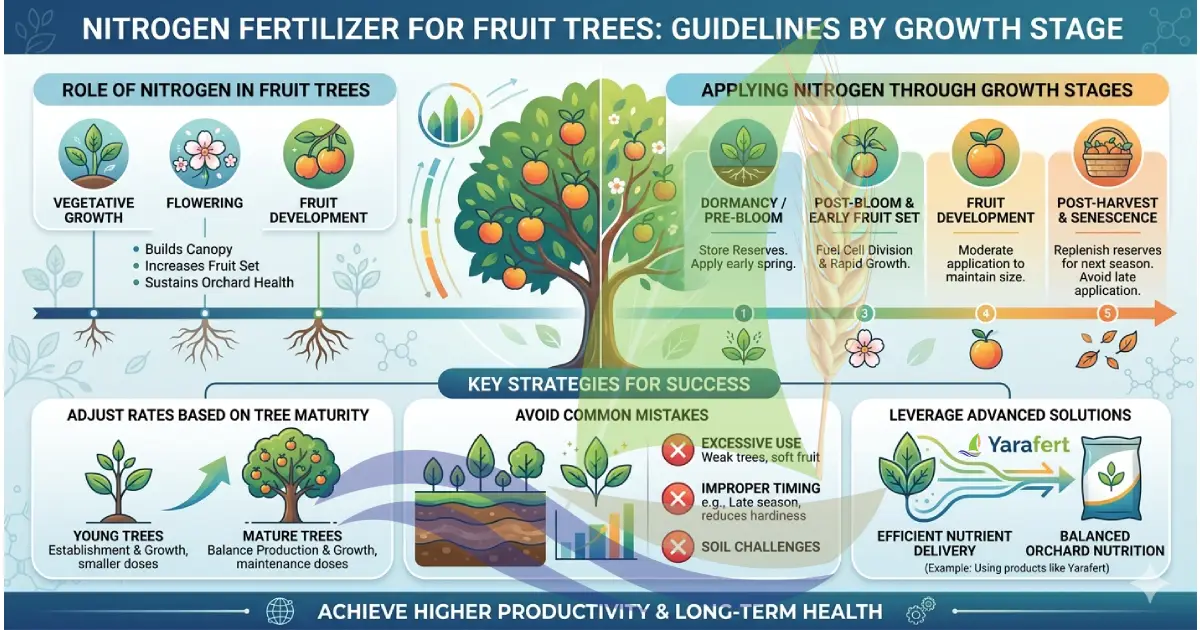
Fruit tree productivity depends heavily on balanced nutrition, and among all nutrients, nitrogen fertilizer plays a central role in vegetative growth, flowering, and fruit development. Applying nitrogen at the correct stage supports canopy formation, increases fruit set, and sustains orchard health over many years. However, improper timing or excessive use can reduce yields, weaken trees, and create long-term soil challenges.
This comprehensive guide explains how to apply nitrogen fertilizer throughout the life cycle of fruit trees, how to adjust rates based on tree maturity, and how to avoid common mistakes. It also highlights how advanced solutions such as Yarafert products support efficient nutrient delivery and balanced orchard nutrition.
Nitrogen Fertilizer During Early Tree Development
Young fruit trees require consistent vegetative growth to establish strong roots and branches. At this stage, nitrogen fertilizer is essential for stimulating leaf formation and photosynthetic activity.
Nitrogen supports the formation of chlorophyll (C??H??MgN?O?), which enables plants to capture sunlight and convert it into energy. Without sufficient nitrogen, young trees often show pale leaves, weak shoots, and delayed canopy development.
To support early-stage growth effectively, growers should follow these core practices:
- Apply small, frequent doses rather than large single applications to avoid root burn.
- Start fertilization after bud break when root activity begins.
- Combine nitrogen with phosphorus and potassium to encourage root expansion.
- Monitor leaf color and shoot length as visual indicators of nitrogen status.
Balanced starter formulations such as Ugarit 27-27-27 + TE or Ugarit 25-25-25 + TE provide young trees with nitrogen alongside phosphorus and potassium, supporting both root and shoot development. Additionally, organic-enhanced formulations like Biofast—containing nitrogen, humic acid, and fulvic acid—help improve soil structure and nutrient uptake during early tree establishment.
Recommended Nutrient Balance for Young Trees
| Growth Stage | Nitrogen (%) | Phosphorus (%) | Potassium (%) | Application Frequency |
|---|---|---|---|---|
| Newly planted | 10–15 | 20–30 | 10–20 | Every 2–3 weeks |
| First-year growth | 15–25 | 15–25 | 15–25 | Monthly |
| Early canopy formation | 20–30 | 10–20 | 20–30 | Monthly |
This balanced nutrition ensures that nitrogen fertilizer supports early development without causing excessive vegetative growth.
Applying Nitrogen Fertilizer for Fruit Set and Yield
Once trees reach reproductive maturity, nitrogen must be applied more strategically. During flowering and fruit formation, excessive nitrogen fertilizer can lead to vigorous leaf growth at the expense of fruit development.
Timing is critical during this stage. Nitrogen should be applied before flowering and again during early fruit development, but reduced as fruit begins to mature.
To maximize fruit yield, growers should follow these stage-specific applications:
- Pre-bloom application: Supports flower bud development.
- Post-fruit set feeding: Maintains nutrient supply during fruit enlargement.
- Reduced nitrogen during ripening: Improves fruit quality and sugar accumulation.
- Combine nitrogen with potassium: Enhances fruit size and color.
High-efficiency nitrogen solutions such as SULPHOMIN, containing 45% nitrogen and 15% sulfur, provide rapid nitrogen availability while supporting protein synthesis and enzyme function. During fruit expansion, pairing nitrogen-rich products with potassium sources like Ugarit K-T-S 25 enhances fruit firmness and overall market quality.
Nitrogen Role in Yield Formation
| Physiological Process | Nitrogen Function | Result in Fruit Trees |
|---|---|---|
| Flower formation | Protein synthesis | Increased blossom density |
| Fruit set | Enzyme activation | Higher fruit retention |
| Fruit growth | Cell division | Larger fruit size |
| Yield stability | Leaf maintenance | Sustained productivity |
Proper management ensures nitrogen fertilizer improves fruit yield rather than causing unwanted vegetative dominance.
How Nitrogen Fertilizer Affects Tree Health Long-Term
Long-term orchard productivity depends on maintaining soil fertility and preventing nutrient imbalances. While nitrogen fertilizer is essential, excessive application can create long-term problems such as soil acidification, weak wood formation, and susceptibility to disease.
Balanced nutrition programs help maintain sustainable tree health across multiple seasons.
The following practices support long-term orchard health:
- Use slow-release or stabilized nitrogen sources to reduce nutrient losses.
- Monitor soil organic matter to maintain nutrient retention capacity.
- Supplement with calcium and magnesium to strengthen cell walls.
- Incorporate micronutrients to support enzymatic functions.
Products such as CALCIMAG, which contains nitrogen along with calcium and magnesium, help reinforce plant structure and reduce physiological disorders such as fruit cracking. Meanwhile, micronutrient blends like SULFOMIX provide iron, zinc, manganese, boron, and molybdenum—essential elements that enhance nitrogen metabolism and plant resilience.
When used responsibly, nitrogen fertilizer strengthens trees, improves wood maturity, and supports consistent orchard productivity for decades.
Adjusting Nitrogen Fertilizer for Mature vs Young Trees
Fruit trees have changing nutrient demands as they age. Applying the same amount of nitrogen fertilizer to all trees can result in overfeeding young trees or underfeeding mature ones.
Young trees require nitrogen to build structure, while mature trees need nitrogen primarily for maintenance and fruit production.
To determine the right nitrogen levels, growers should consider the following differences:
Nutritional Needs by Tree Age
| Tree Age | Nitrogen Demand | Primary Objective |
|---|---|---|
| 0–2 years | High | Structural growth |
| 3–5 years | Moderate | Canopy expansion |
| 6+ years | Controlled | Fruit production |
| Old orchards | Reduced | Maintenance |
For mature trees, nitrogen should be applied in measured amounts to maintain productivity without promoting excessive vegetative growth. Multi-nutrient blends such as Ugarit 40-10-10 + TE support fruit-bearing trees by delivering controlled nitrogen alongside phosphorus and trace elements.
Meanwhile, organic-rich formulations like Ugarit 10-0-5 + 70% Organic Matter improve soil health while providing sustained nitrogen availability. These products allow growers to fine-tune nitrogen fertilizer strategies according to orchard age and productivity goals.
Common Mistakes With Nitrogen Fertilizer in Orchards
Even experienced growers sometimes misuse nitrogen fertilizer, leading to reduced yield and poor fruit quality. Avoiding common mistakes is one of the fastest ways to improve orchard performance.
Before applying nitrogen, growers should carefully evaluate soil and plant conditions. The most frequent mistakes include:
- Over-application of nitrogen: Causes excessive leafy growth and poor fruiting.
- Late-season nitrogen use: Delays dormancy and increases frost damage risk.
- Ignoring soil testing: Leads to nutrient imbalance.
- Uneven fertilizer distribution: Results in inconsistent growth.
- Failure to integrate micronutrients: Reduces nitrogen efficiency.
Balanced fertilization programs often include supporting nutrients such as potassium and sulfur. For example, potassium-rich formulations like Ugarit 10-10-40 + TE help regulate water balance and improve fruit color, while sulfur-based solutions enhance nitrogen utilization efficiency.
Proper management ensures that nitrogen fertilizer supports consistent orchard growth rather than causing long-term complications.
Technical Overview: Nitrogen Forms and Their Behavior
Understanding nitrogen chemistry helps growers choose the right fertilizer type for their orchard conditions.
Common Nitrogen Forms
| Nitrogen Form | Chemical Formula | Characteristics | Typical Use |
|---|---|---|---|
| Nitrate | NO?? | Fast absorption | Immediate growth response |
| Ammonium | NH?? | Slower uptake | Sustained feeding |
| Urea | CO(NH?)? | Converts to ammonium | Widely used fertilizer |
Different nitrogen forms influence how nitrogen fertilizer behaves in soil, affecting nutrient availability and efficiency.
Conclusion and Call-to-Action
Applying nitrogen fertilizer according to tree growth stages is one of the most effective ways to increase fruit yield, improve quality, and maintain long-term orchard health. From early tree establishment to mature fruit production, nitrogen management requires precision, observation, and balanced nutrient strategies.
Modern solutions such as Yarafert products—including nitrogen-rich formulations like SULPHOMIN, balanced blends like Ugarit 27-27-27 + TE, and supportive nutrient solutions like CALCIMAG—provide growers with reliable tools to optimize orchard performance and soil health.
Ready to improve your orchard productivity?
Explore the full range of Yarafert nutrition solutions, consult with agronomy experts, and develop a customized fertilization program tailored to your fruit trees. Contact our team today or visit our product catalog to discover the right nitrogen fertilizer strategy for your orchard’s success.